November 6, 2026
Written and reviewed by George Napier, Founding Attorney at The Napier Law Firm, former Montgomery County Assistant District Attorney who served as a chief prosecutor and as a felony prosecutor.
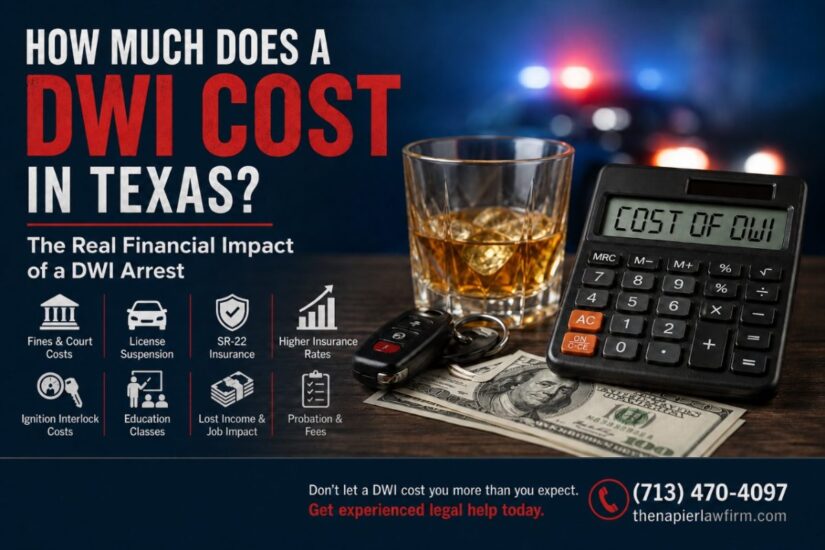
A DWI arrest in Texas can be financially overwhelming. Most people first think about the criminal fine, but the true cost of a DWI can include court costs, a state traffic fine, attorney’s fees, license reinstatement fees, increased car insurance, SR-22 requirements, DWI education classes, ignition interlock expenses, probation fees, missed work, and long-term career consequences.
In other words, the question is not just, “What is the fine for a DWI in Texas?” The better question is, “What will this DWI cost me now, and what could it cost me over the next several years?”
For drivers in Houston, Harris County, Montgomery County, Fort Bend County, Galveston County, and surrounding areas, the financial impact can begin almost immediately after an arrest. That is why it is important to speak with an experienced Texas DWI lawyer as early as possible. Texas considers a person legally intoxicated at a blood alcohol concentration of 0.08%, but a driver can also violate the law when alcohol or drugs affect their ability to operate safely, even below that number. Texas DWI penalties can include jail time, license suspension, criminal fines, and a separate state traffic fine assessed after sentencing. (Texas Department of Transportation)
The Napier Law Firm represents people charged with DWI throughout the Greater Houston area, including Harris, Montgomery, Fort Bend, and Galveston Counties. The firm offers free consultations and 24/7 availability for people facing DWI and other criminal charges. (Napier Law Firm)
The “Sticker Price” of a Texas DWI Is Only the Beginning
When people search for the cost of a DWI in Texas, they often find the statutory fine first. That number matters, but it does not tell the whole story.
A DWI case can create several different categories of financial exposure:
- Criminal penalties, including fines and jail exposure
- State traffic fines, which can be thousands of dollars
- Administrative License Revocation penalties, separate from the criminal case
- License reinstatement fees and SR-22 insurance requirements
- Insurance premium increases
- Ignition interlock, alcohol monitoring, or probation expenses
- Court costs and local fees
- Lost income, missed work, and transportation problems
- Career, housing, immigration, and professional licensing consequences
A DWI dismissal, reduction, acquittal, or favorable resolution may reduce or eliminate some of these costs. A conviction, on the other hand, can create financial consequences that continue long after the court case is over.
For that reason, the cost of hiring a qualified Houston DWI lawyer should be viewed in context. Legal representation is not just about appearing in court. It can affect whether you keep your license, whether evidence is challenged, whether the charge is reduced, whether a conviction can be avoided, and whether you are exposed to long-term costs that could follow you for years.
Texas DWI Fines: What the Law Allows
Texas DWI penalties depend on the facts of the case, prior criminal history, whether there was a child passenger, whether there was a crash or injury, and whether the accused had an elevated blood alcohol concentration.
The basic DWI offense is found in Texas Penal Code § 49.04. Enhancements and repeat-offender penalties are addressed in Texas Penal Code § 49.09.
Below is a simplified overview of common DWI penalty ranges.
| Texas DWI Situation | Possible Criminal Fine | Other Criminal Exposure |
|---|---|---|
| First DWI | Up to $2,000 | Up to 180 days in jail and license loss up to 1 year |
| Second DWI | Up to $4,000 | 1 month to 1 year in jail and license loss up to 2 years |
| Third DWI | Up to $10,000 | 2 to 10 years in prison and license loss up to 2 years |
| DWI with child passenger | Up to $10,000 | Up to 2 years in jail and additional license suspension |
These are not the only costs. Texas also imposes a separate state traffic fine for certain DWI convictions, discussed below. TxDOT lists first, second, third, and child-passenger DWI penalties, along with state fines that may be assessed after sentencing. (Texas Department of Transportation)
The Texas DWI State Traffic Fine: $3,000, $4,500, or $6,000
One of the biggest financial surprises in many Texas DWI cases is the state traffic fine.
Texas used to have the Driver Responsibility Program, commonly known as “DWI surcharges.” That program was repealed. However, that does not mean that all extra DWI-related state fines disappeared. Texas now has a state traffic fine under Texas Transportation Code § 709.001.
For many DWI convictions, the state traffic fine can be:
| DWI State Traffic Fine Category | Amount |
|---|---|
| First DWI conviction within 36 months | $3,000 |
| Second or subsequent DWI conviction within 36 months | $4,500 |
| DWI with BAC of 0.15 or higher | $6,000 |
This state traffic fine is in addition to the regular criminal fine. Texas law also allows the court to waive the fine if the court determines the defendant is indigent. (Justia Law)
This is a major reason people charged with DWI should not assume that a “first offense” is financially minor. Even a first DWI conviction can expose a person to thousands of dollars in state fines before factoring in insurance, license, court, and employment-related costs.
Administrative License Revocation: The Civil License Case That Starts Fast
A Texas DWI arrest can create two separate cases:
The first is the criminal DWI case. The second is the civil driver’s license case, known as Administrative License Revocation, or ALR.
The ALR process is handled separately from the criminal court case. It can lead to a driver’s license suspension even before the criminal case is resolved. DPS explains that ALR applies when a person arrested for DWI refuses or fails a breath or blood test, including a BAC of 0.08 or more for a non-commercial driver. The ALR process is governed by Texas Transportation Code Chapters 524 and 724. (Texas Department of Public Safety)
Timing is critical. In many cases, a driver has 15 days from the date notice is served to request an ALR hearing. If a hearing is not requested, the suspension may begin on the 40th day after notice. If blood-test results are mailed later, the hearing-request deadline may be 20 days from the date of the notice. DPS also lists a $125 reinstatement fee for ALR suspensions. (Texas Department of Public Safety)
The potential suspension periods can be significant. DPS lists a first ALR test failure suspension at 90 days and a first refusal suspension at 180 days, with longer suspension periods for subsequent events. (Texas Department of Public Safety)
Because the ALR case moves quickly, anyone arrested for DWI should contact a Harris County DWI lawyer immediately. Waiting too long can mean losing the chance to challenge the license suspension.
License Reinstatement, Occupational Licenses, and Transportation Costs
Losing your license can become expensive quickly. Even if the fine itself is manageable, the practical consequences of not being able to drive can affect nearly every part of daily life.
A license suspension can create costs such as:
- Rideshare expenses
- Lost income from missed shifts
- Difficulty getting children to school or daycare
- Problems attending probation, court, or treatment appointments
- Risk of additional criminal charges if the person drives while suspended
- Cost and paperwork associated with an occupational driver’s license
In some circumstances, a person may qualify for an occupational driver’s license, which can allow limited driving for work, school, or essential household needs. DPS notes that an occupational license may be available for certain people with suspended licenses. (Texas Department of Public Safety)
DPS also explains that a DWI conviction can require alcohol education, a license suspension of up to two years, a $100 reinstatement fee, an SR-22 requirement, probation, ignition interlock, or an interlock-restricted license. (Texas Department of Public Safety)
For many people, keeping limited driving privileges is one of the most important financial goals in the case. Without transportation, a DWI arrest can threaten a person’s job before the criminal case has even reached a final outcome.
SR-22 Insurance and Higher Auto Premiums
Insurance is one of the most expensive hidden costs of a DWI conviction.
After certain alcohol-related driving offenses, Texas may require an SR-22. An SR-22 is proof of financial responsibility filed by an insurance company. DPS lists Texas minimum liability coverage amounts as $30,000 for bodily injury or death to one person, $60,000 for bodily injury or death to two or more people, and $25,000 for property damage. DPS also states that an SR-22 may be required for two years. (Texas Department of Public Safety)
The filing fee for the SR-22 itself may not be the largest cost. The bigger problem is that a DWI conviction can make a driver appear much riskier to insurance companies. Some insurers may substantially increase premiums, refuse renewal, or decline coverage. Consumer insurance analyses have found that Texas drivers with a DUI or DWI can face steep premium increases, with some reports estimating increases around 62% to 67% depending on coverage assumptions and insurer. (Bankrate)
Because insurance increases may last for years, the cost of a DWI is rarely limited to the year of the arrest. A conviction can continue affecting the household budget long after the case is closed.
For more on this issue, see The Napier Law Firm’s article on how long a DWI stays on your insurance in Texas.
DWI Education Classes and Court-Ordered Programs
A Texas DWI case may require alcohol education or intervention classes. These programs take time, cost money, and can affect a person’s ability to keep or reinstate a driver’s license.
DPS states that a first-offense DWI education course is 12 hours, while a repeat-offender DWI intervention course is 32 hours. DPS also directs drivers to the Texas Department of Licensing and Regulation for approved online and in-person course providers. (Texas Department of Public Safety)
The exact cost of a class depends on the provider and program type. But the financial impact is not limited to the enrollment fee. People may also lose time from work, need childcare, or have to arrange transportation to attend classes.
Ignition Interlock and Monitoring Costs
An ignition interlock device can also increase the financial burden of a DWI case. An ignition interlock device generally requires a breath sample before a vehicle will start. Texas law addresses ignition interlock requirements in several places, including Texas Code of Criminal Procedure Article 42A.408 and Texas Transportation Code § 521.246.
In practical terms, ignition interlock can involve:
- Installation fees
- Monthly device rental or monitoring fees
- Calibration appointments
- Removal fees
- Missed work for service appointments
- Additional consequences for missed tests or failed tests
DPS lists ignition interlock, an interlock-restricted license, and probation as possible consequences in alcohol-related driving cases. (Texas Department of Public Safety)
The exact cost varies by provider and court order, but ignition interlock can turn a DWI case into a monthly financial obligation.
Court Costs, Probation Fees, and Local Expenses
Court costs and probation fees vary by county, charge, case outcome, and court order. In a Houston-area DWI case, a person may face costs tied to:
- Filing and court administration
- Probation supervision
- Drug or alcohol testing
- Community service
- Alcohol monitoring
- Pretrial bond conditions
- Victim impact panels
- Treatment or evaluation
- Copies, records, or compliance documentation
A DWI case in Harris County may not cost exactly the same as a case in Montgomery County, Fort Bend County, or Galveston County. Local court practices, bond conditions, prosecutor policies, and available diversion options can all affect the financial outcome.
The Napier Law Firm handles DWI cases across the region, including Harris County DWI cases, Montgomery County DWI cases, Fort Bend County DWI cases, and Galveston County DWI cases.
Towing, Impound, Bond, and Immediate Arrest Costs
Some DWI costs begin the night of the arrest.
A person may have to pay for towing, vehicle storage, bond, rides home from jail, missed work, and replacement transportation. These costs are often stressful because they arrive before the person has had a chance to speak with a lawyer or fully understand the accusation.
A DWI arrest can also create immediate family and work problems. A person may miss a shift, lose access to a company vehicle, have to explain an absence to an employer, or deal with childcare disruption. Even when the criminal case is defensible, the early financial strain can be significant.
This is one reason early intervention matters. A lawyer may be able to request the ALR hearing, preserve evidence, evaluate bond conditions, review video, and begin looking for weaknesses in the State’s case before the situation becomes more expensive.
Lost Income and Job Consequences
The financial impact of a DWI can go far beyond fines and court costs.
A DWI arrest or conviction may affect:
- Commercial driving jobs
- Jobs requiring a clean driving record
- Security clearance
- Professional licenses
- Nursing, teaching, aviation, government, or law enforcement employment
- Company vehicle privileges
- Background checks
- Promotions
- Work travel
- Immigration status for non-citizens
For people who drive for work, even a temporary license suspension can be financially devastating. For professionals, the long-term cost of a DWI may come from reporting obligations, disciplinary review, or lost opportunities.
A Houston criminal defense lawyer can help evaluate both the criminal case and the collateral consequences that may matter most to your employment, license, or future plans.
A DWI Conviction Can Affect Your Record for Years
A DWI conviction can create long-term financial consequences because it becomes part of your criminal record. That record may appear in background checks for employment, housing, professional licensing, education, and other opportunities.
Some first-time DWI cases may be eligible for deferred adjudication or nondisclosure under Texas law, but eligibility is limited and fact-specific. For example, Texas law excludes several intoxication-related offenses from deferred adjudication eligibility and may impose additional restrictions depending on the facts, BAC level, commercial-license status, and offense type. Texas also has nondisclosure provisions that may apply to certain DWI probation or confinement outcomes. (Justia Law)
The key point is simple: the outcome matters. A dismissal, reduction, acquittal, deferred disposition, or nondisclosure-eligible result may have a very different financial impact than a straight conviction.
Can a Lawyer Reduce the Financial Impact of a DWI?
A lawyer cannot promise a dismissal or a specific outcome. But a strong DWI defense may reduce the financial damage by challenging the State’s evidence and pushing for the best available resolution.
Important defense issues may include:
- Whether the traffic stop was legal
- Whether the officer had reasonable suspicion or probable cause
- Whether field sobriety tests were properly administered
- Whether body-camera or dash-camera video supports the officer’s claims
- Whether breath testing procedures were followed
- Whether blood was drawn lawfully
- Whether the lab handled and tested the sample correctly
- Whether the driver was actually “operating” the vehicle
- Whether medical conditions affected the evidence
- Whether the State can prove intoxication beyond a reasonable doubt
Blood and breath testing issues can be especially important. In Missouri v. McNeely, the U.S. Supreme Court rejected a blanket rule that alcohol dissipation always creates an emergency allowing a warrantless blood draw. In Birchfield v. North Dakota, the Court treated breath and blood tests differently under the Fourth Amendment. In State v. Villarreal, the Texas Court of Criminal Appeals addressed warrantless, nonconsensual blood testing in a DWI case. These cases show why the legality and reliability of testing can matter in a Texas DWI defense. (Justia Law)
The Napier Law Firm’s DWI defense work includes reviewing the stop, the arrest, field sobriety evidence, breath or blood testing, procedural issues, and possible negotiation strategies. The firm also notes that it charges flat-rate fees and offers payment plans, which can help clients understand the cost of representation up front. (Napier Law Firm)
Example: Why a “First DWI” Can Become So Expensive
A first DWI in Texas may sound manageable when someone only looks at the “up to $2,000” fine. But the real cost can grow quickly.
A first-time DWI defendant may face:
- A criminal fine
- Court costs
- A state traffic fine of $3,000, or $6,000 if BAC was 0.15 or higher
- ALR license suspension
- License reinstatement fees
- SR-22 insurance requirements
- Increased insurance premiums
- DWI education classes
- Probation fees
- Ignition interlock or monitoring
- Towing and impound
- Bond expenses
- Lost income from court dates
- Transportation costs
- Long-term background-check consequences
This is why the cost of a DWI is not just a legal issue. It is a financial planning issue, a career issue, and often a family issue.
Example: Why a Repeat DWI Can Be Financially Devastating
A second or third DWI can be far more expensive than a first offense.
A second DWI can carry a higher criminal fine, longer jail exposure, longer license suspension, higher state traffic fine exposure, increased insurance problems, and more restrictive bond or probation conditions. A third DWI can be charged as a felony, with prison exposure and a potential criminal fine of up to $10,000. TxDOT lists a third DWI penalty range of 2 to 10 years in prison, a fine up to $10,000, and license loss up to two years. (Texas Department of Transportation)
For repeat offenders, the financial risk is not limited to “paying more.” A felony DWI conviction can affect employment, housing, professional licensing, civil rights, and future sentencing exposure. Anyone facing a repeat DWI should speak with a defense attorney immediately.
How to Protect Yourself Financially After a Texas DWI Arrest
After a DWI arrest, the steps you take early can affect both your legal case and your financial exposure.
1. Do not ignore the ALR deadline
The ALR hearing deadline can arrive quickly. Missing it can mean an automatic suspension. DPS explains that a hearing request is generally due within 15 days from the date notice is served, with different timing when notice is based on later blood-test results. (Texas Department of Public Safety)
2. Preserve evidence
Video, witness information, receipts, medical records, and location data may matter. The sooner a lawyer gets involved, the better the chance of identifying evidence before it disappears.
3. Avoid new violations
Driving while suspended, missing court, violating bond conditions, or ignoring an interlock requirement can make the case more expensive and more serious.
4. Understand the full cost before accepting a plea
A plea may include more than the fine announced in court. Before resolving a DWI case, make sure you understand state traffic fines, license consequences, SR-22 requirements, insurance impact, probation terms, and record consequences.
5. Hire a lawyer who handles DWI cases regularly
DWI defense involves criminal law, constitutional law, scientific testing, administrative license rules, and local court practice. The right defense strategy can make a meaningful difference.
Frequently Asked Questions About DWI Costs in Texas
How much is a first DWI in Texas?
A first DWI can carry a criminal fine of up to $2,000, up to 180 days in jail, and license loss up to one year. In addition, Texas may assess a state traffic fine of $3,000 for a first DWI conviction within 36 months, or $6,000 if the BAC was 0.15 or higher. (Texas Department of Transportation)
Are Texas DWI surcharges still a thing?
The old Texas Driver Responsibility Program surcharge system was repealed. However, Texas still has a separate DWI state traffic fine under Transportation Code § 709.001. So while the old “surcharge” terminology is outdated, a DWI conviction can still trigger a major state fine. DPS confirms that the Driver Responsibility Program has been repealed, and TxDOT lists current state DWI fines assessed after sentencing. (Texas Department of Public Safety)
Can I lose my license even if I am not convicted?
Yes. The ALR license case is separate from the criminal DWI case. DPS explains that ALR is a civil administrative process that is unrelated to criminal court proceedings and can apply when a driver refuses or fails a breath or blood test. (Texas Department of Public Safety)
Will a DWI increase my insurance?
A DWI conviction can substantially increase insurance premiums and may require an SR-22. DPS states that an SR-22 may be required for two years, and consumer insurance reports show that Texas drivers can face significant premium increases after a DUI or DWI. (Texas Department of Public Safety)
Can the $3,000, $4,500, or $6,000 state traffic fine be waived?
Texas Transportation Code § 709.001 allows the court to waive the state traffic fine if the court determines the defendant is indigent. The availability of a waiver depends on the court’s finding and the defendant’s financial circumstances. (Justia Law)
Is it worth hiring a DWI lawyer if the case is a first offense?
Yes, for many people it is. A first DWI can still involve license suspension, state traffic fines, insurance increases, SR-22 requirements, court costs, probation, education classes, and a criminal record. A lawyer may be able to challenge the stop, the arrest, breath or blood testing, field sobriety evidence, and procedural issues. The goal is not only to handle the court date, but to reduce the long-term financial and personal damage.
Talk to a Houston DWI Lawyer About the Real Cost of Your Case
A Texas DWI can cost far more than the fine printed in the statute. It can affect your license, insurance, job, record, family, and financial future.
The Napier Law Firm helps people charged with DWI in Houston, Harris County, Montgomery County, Fort Bend County, Galveston County, and surrounding Texas communities. Whether this is your first arrest or you have prior DWI history, the firm can review the facts, explain your options, challenge the evidence, and help you understand the financial risks before you make decisions that could affect your future. The firm offers free consultations and is available 24/7. (Napier Law Firm)
Call The Napier Law Firm today at (713) 470-4097 to schedule a free consultation with a Houston DWI defense lawyer.
Legal disclaimer: This article is for general informational purposes only and does not create an attorney-client relationship. DWI penalties and financial consequences depend on the facts of the case, criminal history, court, county, and applicable law. Consult a Texas criminal defense attorney about your specific situation.